Showing posts with label NYU. Show all posts

Sunday, December 14, 2008

Reflections on a Gaming Semester

I'm a Video Game Production major at NYU. I'm sure that confuses some people, since NYU just announced they will have video game majors starting NEXT year. At my school in Gallatin we get to create our own concentrations, and mine is in Video Game Production. I guess that means I'm slightly ahead of the curve? What's nice though is that NYU is starting a masters program in gaming in Fall 2010, which is the semester right after I graduate. If I pull the right strings I might have a way into that, unless, of course, I find an good-paying job out of undergrad. Eh, whatevs.


Being that I'm a junior, my academic career is flying full throttle. I took four classes this semester. Digital New Media, Game Production, Culture as Communication and Hackers: Culture and Politics. All four of these classes blended together extremely well, and I felt that each discussion in these classes were extensions of a previous conversation I had in different class but with a different spin on it.

The first example of this happening was when I talked about Jorge Luis Borges and the Garden of Forking Paths. I had to read that short story for both my Digital New Media class and my Game Production class. In game production we looked specifically at the labyrinth the main character walks through in order to find the person he needed to kill. We took that winding labyrinth idea and made our own 3D models of of a labyrinth. Hence the Lego Labyrinth post I made earlier.


In Digital New Media, we took Borges' story and analyzed it terms of hypertext. By killing a prominent person who was also the name of a city, Borges showed a hidden meaning embedded with his the actions of his character. The idea of hypertext also blended into other topics in Digital New Media, the obvious one being how we use hyperlinks to continue a line of thought or a narrative.

I thought it was neat that my classes complimented each other in little bits early in the semester. By the end of the semester though, everything I was doing was becoming part of one big wheel, and content was getting recycled with different lenses in different classes. I remember watching McLuhan's Wake in Digital New Media while reading McLuhan's Understanding Media in my Culture as Communication class. McLuhan's Wake was a film produced by Marshall McLuhan's son that took McLuhan's ideas of the "medium is the message" and "hot and cold media," along with many others and used them in a film format.

For those who don't know, McLuhan is one of the pioneers of new media studies. I recently wrote a paper on how McLuhan would probably look at the interpersonal relationships between people while they play video games. You can read that paper through this link.


I also read Henry Jenkins' Convergence Culture and I took one his ideas--Trans-Media Storytelling--and decided to do a final project for my Digital New Media class with Jenkins in mind. The concept behind Trans-Media Storytelling is that current media have the ability to take one storyline and extend it over different mediums. For example, The Matrix is a three part movie series. However, the story is also extended in the Animatrix anime series and in the Matrix Online game.

For my take on his theory I made a Little Big Planet level that focused more on a narrative, while still having quite a bit of gameplay. I recorded the level with voice acting and made it into a video on YouTube. The video is also posted on this site, right before this post. The Little Big Planet level is just one step in a trans-media storytelling format. By making a video, I move the game into another medium, and since I made the level copyable, someone could take my design, improve upon it, or even continue the story.


The Little Big Planet level isn't the only project I was working on this semester as well. For my Game Production class, I had to create a game using programs such as Autodesk Maya and Virtools, which both focus on making 3D environments. After much deliberation and tons of time spent learning the software, I was able to create (fairly) working demo and a level design document that lays out the goals of the game, the inspiration and a timeline of various models. I have a screenshot of what the game looks like below (called Clockwork), and you may notice that the level design was inspired by the Lego Labyrinth.


I do plan on finishing the game, at least just the first level. I plan on having it out before the end of December and it will posted on this site first. Shawn was awesome enough to record some music for the game, and he linked to you it in his most recent, and first, post on this blog.

The story for Clockwork is pretty straight forward. You're a worker inside of a gigantic clock constantly being watched over by what looks to be drones. Your character decides that he can't take it anymore and decides to leave his post working on the gears. In order to escape from the clock, you need to solve a series of puzzles to unlock the path to the exit. And being that you're in a place filled with gears, many of the walls and floors turn, which add to the puzzle frenzy.

This whole story is explained without words, mostly because gamers playing a puzzle-action game probably don't want to read story. Instead, the above passage is explained just through animation. A video game narrative doesn't need words to be effective, at least, in my opinion. Why is this the case? Sherry Turkle, a writer I mentioned in a previous post gives her view on the subject. Turkle suggests that gamers care less about narrative in games because the interactivity of a game already allows them to create their own story, even if they are trapped in a highly rule-based world.Even though Turkle made those observations in the 1980's, some of her perceptions still hold true today.

I actually learned a lot about video game history this semester, though that knowledge surprisingly came from my Hackers: Culture and Politics course. I didn't know that the makers of the Atari 2600 were a bunch of hackers, and I also found out where the 2600 came from. I wrote a whole history about the 2600 on Will and Beyond, so check it out if you want to find out more.


I think the most important thing I learned this semester relating to video game production is that in order to create something successful, you have to look at it from an interdisciplinary point of view. Gameplay isn't the most important thing, as I always have said in the past. The look and feel of a game, the story, the music, the entire development team; they all need to work together.

Games aren't all about the content either. McLuhan taught me to look at the interactions outside of the content and Jenkins showed me that video games aren't a closed medium; they seep into almost all of the other media that we have. And while games should be focused on making gamers happy, games are so integrated into our culture that they affect the growth of business, music, film, and ourselves. To ignore the appeal of games to any person would be taking a very narrow mindset.

Next semester will be interesting as well. I'm taking a class on game art, another in advanced photoshop, a class about evil characters in stories, a class on reading and theorizing film and my internship with Illclan, an animation company that produces Machinima.

Saturday, December 13, 2008

Little Big Planet- The Owl Collector

One of my many final projects was to create a Little Big Planet level/film. I learned a lot about how different mediums combine together in my various classes at NYU this year. Whether is was McLuhan's theories on hot and cold media, or Jenkins' idea of convergence culture, each of them suggested a melding of mediums. So, I decided to take their ideas into practice and create a little big planet level with some basic story elements and voice acting. The result is shown below.


Alright, so it's not THAT funny, but I thought it was pretty cute for what Little Big Planet is. Making the level took about 4-5 days of work; most of it being spent on testing and re-testing gameplay elements (the falling blocks part was a bitch).

The gameplay and script was created by me and the characters used are characters Media Molecule had in the story mode. The fantastic voice-acting was all performed by my roommate, Garrett.

Yeah, I know. The quality sucks. Eventually I may have a (working) adapter that allows me to plug my PS3 into my computer. If and when that happens I'll recorded this video with better quality. Even with this quality though, my professor and classmates seemed to love it when I presented it. I think I also blew their minds when I showed how the gameplay mechanics work.

I'm still impressed at the amount of tools Little Big Planet has for the level editor. I was even able to affect the camera angle at the end so you could see the catapult activating. Crazy stuff. If you have LBP and you would like to play this level, search for "The Owl Collector" in LBP. And if you like it, please heart it! I need 5 hearts in order to get a trophy.

Expect a Little Big Planet review in the upcoming week.

Video Gaming with McLuhan

I wrote this paper for my Culture as Communication class. The essay looks at McLuhan's theories on media, and sees how well his theories would apply to video games. Since McLuhan always pushed the "medium is the message" idea, I analyze the interactions between people as they play video games, while under a McLuhan lens. Being that the paper is academic, read only if you're looking for something fairly intelligent sounding.
--------------

Video Gaming with McLuhan

Marshall McLuhan introduced a revolutionary idea to media studies. Instead of examining the new content in the media, McLuhan looked at the interpersonal relationships forming because of the new medium. He was more concerned with the human interaction than with the subject itself. I only wish that McLuhan would have been alive to study and remark on the environments that current video games create. There have been hundreds of studies that look at the effects of violent video games, but few have looked at the interpersonal relationships that form around this new medium.

A common misconception of video gamers is that they become glued to the action on the screen and do not interact with the players around them. Yet, whenever I host a video game club event in NYU, the room is loud not because of the television, but because of the people interacting (more like yelling) with one another. As play occurs, the people become more in tune with their characters or avatars and as their characters win or lose, they mimic the feeling of joy or despair in the real world.


Mocking, cheering, gloating, cursing and anger are just some of the emotions expressed in the multiplayer experience that exists out of the gaming world. For “play,” whether in life or in a wheel, implies interplay. There must be give and take, or dialogue, as between two or more persons or groups” (McLuhan, 240-241). The discussions outside of the game are particularly odd because a game allows the parties involved to be cruder. Calling someone a loser or a n00b is mean but, a gamer has no choice but to accept the insult, and retort with an even better insult. In addition, the better your rhetoric is, the more you will impress your opponent and you will bond closer together both inside and outside the gaming environment.

Why does this happen? Multiplayer gaming is a forced competitive environment and since you are battling in a virtual world, it only seems natural to extrapolate the virtual competition into the real world, and have a competition in rhetoric. And when you eventually win a battle—especially in something like a fighting game where there is a clear cut winner—the jubilation of the character animation and the player may often times be one of the same. “Games, like institutions, are extensions of social man” (McLuhan, 235). Though we may not be battling with swords in the real world unlike our virtual counterparts, we find other ways to compete.


The need for competition in both the virtual and real world may be brought further to light by McLuhan’s theories about hot and cold media. Simply put, hot media is any medium that is high in data but low in participation, while cold media is low in the amount of information but high in participation (McLuhan, 23). Video games seem to break from this mold as they are both high in participation and in data. The user playing a video game is being inundated with visuals and sound while inputting commands on a controller and potentially conversing with his or her neighbor. Participation, in this case is both mental and physical.

The visual and sound power of a movie, on the other hand, is such an overload of data that the watcher is forced to be quiet and process all that is happening within the screen, making it clearly a hot medium. Video games have a similar level of focus since each player looks closely at how the character is interacting with the environment when he or she inputs commands. However, since the inputting of commands forces us to participate in order to enjoy the medium, we naturally participate in the real world as well.

Another reason why we might be more prone to talking in real life while playing video games is that we have a closer tie with the character than that of movie characters. We control the movements and actions of the avatar but the technology is not advanced enough yet that we can control their speech and make it our own. It is possible that since we control the character in some elements, we feel the urge to speak so that we can further complete our connection to the avatar and make the gaming experience a closer match for the extensions of ourselves.


Video games force the user to multitask since there is interaction with a visual object. Since we have the senses of sight and touch covered, the hot media environment we live in may force us to connect with the gaming experience orally as well. Instead of cutting our minds off from an oral interaction, we may feel compelled to discuss while gaming so that we do not overload one of our stimuli. This idea slightly differs from McLuhan who suggests that our bodies self-amputate in hot media situations. “The function of the body, as a group of sustaining and protective organs for the central nervous system, is to act as buffers against sudden variations of stimulus in the physical and social environment” (McLuhan, 43).

It’s hard to argue that we, living in New York City, do not live a hot media society. The internet is loaded with information that we can access at any time now, thanks to the availability of cell phones and laptops. However, instead of blocking ourselves off from the stimulus, we engage with it. The want to know information is very much a gaming quality since it is akin to exploration. The fact that we can handle all the information and play with it might show that we are attempting to cool down our environment in order to make use of all of our senses.


With video games the environment seems to protect its users from self-amputation. You are aware that the player sitting next to you is engaged in the same competition experiencing similar emotions to you while participating in the content. The urge to share your feelings is strong, just as it is when watching a movie with a friend. However, the difference is that since you are changing the content, you feel more ownership to the experience and have no qualms discussing the experience mid-gameplay.

Gamers are a social bunch when partaking in a multiplayer experience. The interactions may be a product of the “warm” medium that it is, since video games are filled with data and participation. Regardless, McLuhan may have made some changes to his theories based on the relationships that form with video gaming. Hot and cold media might have to be re-evaluated and the self-amputation concept might have to be entirely remodeled since video gamers seem to counteract that belief. Since McLuhan never witnessed digital play on something of this magnitude, I am sure our society would influence the development of his theories.
-----------

The book referenced in this essay is McLuhan's Understanding Media.

Feel free to debate my ideas expressed in this paper. I'm sure there are some holes in my argument that people can address.

Friday, December 12, 2008

Digital New Media Timeline (#40 - #54)

These timelines are the last few in the New Media Reader. They cover all of the major technological and cultural advancements in New Media between 1986 and 1994. New Media has blossomed since then, of course, but the New Media Reader gives an excellent history of all what came before it.

#40- Mythinformation
Langdon Winner, 1986
-- Mythinformation is the belief that the adoption of computers and technology into our culture will create a better world for all of humanity.
-- Winner believes that information is knowledge and that have clear access to that information will enhance democracy and social power.

#41- From Plans and Situated Actions
Lucy A. Suchman
-- Suchman made advances in artificial intelligence by suggesting a different method as to how the human mind makes decisions. By saying that people don't create abstract plans of thought, engineers are able to look at intelligence differently and therefore create better AI overall.
-- Suchman's work goes hand-and-hand with Seymour Papert, Alan Turing and Ben Shneiderman, all who have been mentioned in the New Media Reader before.

#42- Siren Shapes: Exploratory and Constuctive Hypertexts
Michael Joyce, 1988
-- Joyce provides definitions for different types of hypertext and hyperlinks. Constructive hypertexts are links created by the author. Exploratory hypertexts are links to another author's work.
-- It rare that we see constructive hypertext formats. Is this because there is just so a wealth of information on the web that we do not need to create our own hypertexts?

#43- The Work of Culture in the Age of Cybernetic Systems
Bill Nichols, 1988
-- Nichols discusses the shift in culture with the birth of video games and other simulation media. He argues that video games can be liberating as they provide freedom of movement.
-- He also argues that the liberating freedom of video games is not a huge leap in computer interaction because video games function in a highly rule-based environment.

#44- The fantasy Beyond Control
Lynn Hershman, 1990
-- Hershman's Lorna is the considered to be the first interactive video art installation.
-- People who witnessed this project were able to make choices with what they see from the piece, making Hershman's project an interesting blend of video games and high art.

#45- Cardboard Computers
Pelle Ehn and Morten King, 1991
-- Ehn and King were dedicated to working with computer users, both experts and new, in order to create new media tools. This constant sharing and giving back is common thoroughout computer history; capitalist style software only gained momentum when Bill Gates made BASIC proprietary.
-- This method of working is still very popular in Internet communities today and were heavily influenced by Ehn and King's Utopia project.

#46- The Lessons of Lucasfilm's Habitat
Chip Morningstar and F. Randall Farmer, 1991
-- Lucasfilm's Habitat project was one of the first to create large-scale, commercial, graphical virtual environment. That means that MMORPGs like World of Warcraft were somewhat influenced by Lucasfilm's design.
-- Using a two-and-a-half dimensional view, Habitat wasn't exactly popular but, it laid the foundations for many games after its inception.

#47- Seeing and Writing
J. David Bolter, 1991
-- Bolter discusses the effects computer text programs have on how we perceive writing. He argues that the movement of writing on a computer screen relates very similar to traditional writing and that is doesn't need to be that way.
-- Bolter reminds us that technology, whether that is simply just writing, or a typing program, can influence how we communicate.

#48- You Say You Want a Revolution?
Stuart Moulthrop, 1991
-- Moulthrop argues that hypertext on the Internet is not a replacement of a traditional book, but rather a replacement for television.
-- Moulthrop suggests that a when a medium reaches its limit of influence, it will reverse, become more participatory and homogeneous.

#49- The End of Books
Robert Coover, 1992
-- Coover expresses a fear that has come along with almost every new technology. Will the Internet be the dagger that ends the book era? No. Tradition shows that books stay as a medium, no matter how powerful the influence of the new technology is.
-- There have been many successful authors who have used new media ideas in their stories, two prominent examples being Joyce to Borges.

#50- Time Frames
Scott McCloud, 1993
--McCloud is a famous and clever comic artist. His comic is a comic inside of comic and views his work as sequential art.
-- His commentary of what happens within a comic looks and feels like a comic twist on the principles of hypertext.

#51- Surveillance and Capture: Two Models of Privacy
Philip E. Agre, 1994
-- Agre expresses a fear that the private information we place on the internet will eventually allow authorities to capture our information and have more control over and live and experiences.
-- Agre makes references to Foucault's panopticon and while he believes surveillance will become more widespread, Agre thinks the Web provides a medium so open to sharing that we will give up our information too easily.

#52- Nonlinearity and Literary Theory
Espen J. Aarseth, 1994
-- Aarseth wrote an excellent essay as to how literature has changed with the birth of the internet. He tells us that stories are becoming more nonlinear in nature, jumping from thought to thought and place to place.
-- Nonlinearity was popular among bards as storytellign technique before the explosion of writing. McLuhan would probably argue that since the internet brews stories that harken to back to oral cultures, the internet is therefore then cooling down our hot media society.

#53- Nomadic Power and Cultural Resistance
Critical Art Ensemble, 1994
-- The critical art ensemble feared that the open nature of the internet did not give power back to the individual but made the "power elite" more powerful.
-- With cyberspace, organizations have less physical space from which people can resist, and therfore the only way to effectively resist the power of an organization you disagree with, is to create cultural rsistance on the Web.

#54- The World-Wide Web
Tim Berners-Lee, Robert Cailliau, Ari Luotonen, Henrik Frystyk Bielsen, and Arthur Secret, 1994
-- The World-Wide Web seems to be the cumilnation of hypertext in its finest from, but it falls short in some areas.
-- The Web is a great source from almostall of human knowledge, that is, if people are willing to unbiasly transport the data gained in books of past generations to the web.
-- The cost of the internet does make it difficult for the poor to be connected, but at least in America, Barack Obama is dedicated to getting every child online.
-- Even in 2008, we are still unsure about the internet's effects on how culture and language. Online privacy is also an unresolved issue that may have major ramications on how gain or loss some of our freedoms.

Note: Hyperlinks and reactions are to be added later in an update of this post.

Tuesday, December 9, 2008

Digital New Media Timeline (#25 - #39)

As I'm drawing near the end of the semester, I have finished more of the New Media Reader for my Digital New Media class. Featuring articles from the late 70's and early 80's, these selections show how perceptions of the computer constantly changed and we also see the birth of video game technologies, how they were percieved and how they affected the growth of new media.

#25- Responsive Environments
Myron W. Krueger, 1977
-- Kreuger is often placed as "the father of virtual reality" and his ideas on how a computer can interact with humans may have influenced, on a long-term scale, the makings of the game Second Life.
-- Krueger argues that the "response is the medium," unlike McLuhan's assertion that "the medium is the message."

#26- Personal Dynamic Media
Alan Kay and Adele Goldberg, 1977
-- Kay and Goldberg were the first to see the computer as an all-purpose moveable machine (a.k.a. laptops) for anyone to use.
-- Kay was part of Atari's short-lived research lab that was dismantled after the first video game industry crash.

#27- From A Thousand Plateaus
Gilles Deleuze and Felix Guattari, 1980
-- As philosophers, Deleuze and Guattari raised issues in metaphysics and epistemology, and hinted that computers could create unstable identities for humans.
-- They introduced the idea of rhizomatic writing which, simply put, is how one writes to exude hypertext (think Borges).

#28- From Mindstorms: Children, Computers and Powerful Ideas
Seymour Papert, 1980
-- Papert made a programming language called LOGO that was designed to teach children an easier programming language.
-- Though the beginnings of video games were slowly bringing a younger audience to computers and technology, Papert was dedicated to bringing the creative powers of a computer to children.

#29- "Put-That-There"
Richard A. Bolt, 1980
-- Put that there is an interface that combines speech and gestures to have interaction a computer. Voice-activated technology is still being improved today, and Bolt pioneered in in 1980.
-- Bolt's "Put-That-There" was an attempt at making the computer a more intuitive human-like technology.

#30- Proposal for a Universal Electronic Publishing System and Archive
Theodor H. Nelson, 1981
-- The title of this chapter says it all. Nelson was not only suggesting a digital library system (i.e. the web) but, also his ideas influenced the concepts of Weblogs, or just blogs.
-- While the ideas of hyperlinks are understood now, Nelson how to lay out, piece-by-piece, how hyperlinks would work and help computer users.

#31- Will There Be Condominiums in Data Space?
Bill Viola, 1982
-- Bill viola is a famous early video artist who has been featured at big museums like Whitney museum.
-- Viola makes an argument that the video is an improved extension of the human memory.

#32- The Endless Chain
Ben Bagdikian, 1983
-- Bagdika argues that all media is part of chain that eventually become connected through one form or another.
-- Compatibility is important for old media to survive. In order for radio and television to stay alive in our new media environment, Bardikian argues that they need to adapt to the culture and find a way to seep into new mediums.

#33- Direct Manipulation
Ben Shneiderman, 1983
-- A Direct Manipulation system suggests that what happens on screen will mimic what the user is doing. For example, if you shoot a gun in a video, a direct manipulation tactic would be to have the button be trigger, like the Z-button on the N64.
--Shneiderman argues that computer should move towards a direct manipulation system so to make it easier for new users to use the computer.

#34- Video Games and Computer Holding Power
Sherry Turkle, 1984
-- Turkle studied how people act when they play games. She noticed that when people play a pinball machine, they move their bodies to emulate the ball. However, when people play something like Pac-man, they hardly move at all even though that they are the big yellow mouth. One theory on why there is less movement is because the lack of a physical space for the game forces people to become immersed with the visual experience and therefor exude no kinetic experience.
-- Turkle also suggests that gamers care less about narrative in games because the interactivity of a game already allows them to create their own story, even if they are trapped in a highly rule-based world.

#35- A Cyborg Manifesto
Donna Haraway, 1985
-- Haraway argues that a cyborg would be a better image for women to pursue than a goddess since cyborgs deal with the "here and now."
-- Haraway also argues that computers and technology can be liberating for women and that if used properly, can help drive a socialist-feminist movement with their communicative powers.

#36- The GNU Manifesto
Richard Stallman, 1985
-- Stallman is probably the most famous free software hacker ever. His GNU project attempted to create a operating system that would rival UNIX and be completely free and open source.
-- Stallman is also famous for helping drive the "copyleft" movement, which is essentially a culture full of sharing information and no intellectual property. In essence, it's the opposite of copyright laws.

#37- Using Computers: A Direction for Design
Terry Winograd and Fernado Flores, 1986
-- These two authors argue that computers should not try to emulate artificial intelligence and focus more on using the computer as tools to help people with tasks and design.
-- Their plea made programmers reconsider the effects of computers and some people began to see the computer as just a powerful machine, not a human-like machine.

#38- Two Selections by Brenda Laurel
Brenda Laurel, 1986, 1991
-- Laurel helps layout the differences between different dramatic elements in drama and human-computer activity. The overall difference human-computer activity is more interactive and that human-computer activity uses more graphical "language" for pleasure.
-- Plot, especially in video games becomes very blurred. Laurel argues that new media technologies will alter how we view drama.

#39- Towards a New Classification of Tele-Information Services
Jan L. Bordewijk and Ben van Kaam, 1986
-- These authors look at the social role of media, and foresaw a change in language and how people converse. IRC channels and even conversations in various MMORPGs are predicted in this essay, years before their conception.
-- Their ideas on how information travels formed the foundations for new media studies.

Note: Hyperlinks and reactions are to be added later in an update of this post.

Sunday, November 9, 2008

Machinima Filmfest 2008

I went to the Machinima Filmfest 2008 award ceremony last weekend and my mind was blown. For those who don't know what Machinima is and ignored the wikipedia link, Machinima is essentially video game movies. Not like the awesome awesome (that's not a typo, it deserves two awesomes) Super Mario Brothers movie with Bob Hoskins and Dennis Hopper. Machinima takes in-game video game characters and sprites and reapproiates them to make video game movies. Some of the movies stay within the world of the game, others take the characters and make a whole new storyline unrelated to that game's universe. Needless to say, Machinima appeals to gamers and off-center film directors.

Why use Machinima for animation? ILL clan animation studios puts it best: "Simply put? Machinima Animation can provide you with high-quality animation produced three times faster than traditional 3D CGI animation at 20% of the cost."


Before the awards ceremony, there were a series of panels that talked about machinima. One panel discussion featured young high-school students who used environments they created in Second Life to raise some global issue. By using the game's mechinics, they made a successful film that asked questions and discussed problems within Second Life.

Another panel talked about copyright issues with machinima and the business behind it. One machinima filmmaker got his film on HBO and was able to retain all of the rights to the characters within his film because the avatar he used was created by himself in Second Life, making it intellectual property. However, since he was making revenue off this film, random avatars that came into his set while filming might have needed contracts in order to be recorded. Considering very few films have been made and marketed in virtual worlds, copyright issues are fuzzy.

The most exciting part of the day though, was clearly seeing all of the movies. In one room, they had a huge projector which just streamed the films all day long until the awards ceremony came up.

Instead of going through and talking about each film, I'll just put a whole bunch of them up in this post that I really liked. You can make your own distinctions and conclusions about the films.

Tiny Nation:


Beast:


Molotov Alva and His Search for the Creator


Ignis Solus


Portal: A Day in the Life of a Turret


If you want a list of all of the nominated films for Machinima filmfest 2008 check out this list here.

Monday, November 3, 2008

Play Money, Virtual Worlds and Ludocapitalism

Don't run away just cause you saw the word "capitalism" in the blog post title. This post is about gold farming in online games like World of Warcraft, Ultima Online, Second Life, etc. I recently read this book called Play Money by Julian Dibbell and went to a lecture he had at NYU. Dibbell has an interesting story to tell: he was a gold farmer who made made thousands selling virtual gold and items on eBay. If he had gold farmed full-time and quit his writing job, he would have made more than enough money to support himself and his family; all while working at home playing games.

Below is a response paper I just finished writing for my "Hacker Culture and Politics" course relating to Dibbell's book, ludocapitalism (don't worry, I explain it), and the pleasures of work as play. It's definitely academic, but you should enjoy it.
------------------------

Julian Dibbell’s brief venture to gold farming in virtual worlds may have caused him to discover what may be the driving force of capitalist economies in the 21st century: Play. Ludocapitalism, as Dibbell puts it, is a belief that looks at the labor experience as a game and it could drive economies both virtual and real. This concept works because some theorists, as writer Martha C. Nussbaum highlights, believe that play and pleasures are the never-ending goals of human existence.


By the second half of Dibbell’s book, Play Money, Dibbell is deep into adventuring in Ultima Online (UO), a massively multiplayer online role-playing game (MMORPG), and he is raking hundreds of dollars each week buying and selling virtual goods. Instead of killing enemies and participating in traditional quests, Dibbell has decided to play game within the game world of UO, becoming a trader who sells items and gold within the game and on auctioning sites like eBay.

The goal of the Play Money project was to make more money gold farming than Dibbell has even made in a year as writer. Though he just barely failed in that goal in the end, Dibbell does admit that selling virtual goods is a viable form of living; “a $47,000 income wouldn’t have topped my best year writing, no—but on the other hand, to be honest, it would have topped all the other years” (Dibbell, 292). Since gold farming is productive then, virtual world trading is one of the first steps in actively pursuing a ludocapitalist economy.

At the lecture Dibbell gave at NYU, Dibbell makes a strong argument as to how work as play can be productive, and fun. Dibbell said that he visited a “Chinese gold farming sweatshop” in which tens of workers played World of Warcraft (WoW, another MMORPG) for 12 hours a day, seven days a week as their regular job. Despite constantly doing the same tasks over and over again, even when these workers received their break, they played their personal accounts on World of Warcraft and discussed how they could improve on their characters. The physical social environment of the sweatshop still made the game fun—despite the tedious tasks—since they were playing a game.


While working, many of these gold farmers stare at trading markets all day, buying low and selling high. Some of them run around in virtual cave, mining ore and creating swords with some simple keystrokes and clicks. The monotony seems similar to that of a cubicle job, checking for typos on documents and creating cover sheets for business plans. Yet, online players feel a sense of pleasure in their work; why is this?

One answer may be because games like World of Warcraft are encouraging in their nature. When you successfully mine, you may get a message saying your mining skill increased, which is rewarding and self-encouraging. The game is constantly telling you how you are improving, while most desk jobs do not. The social environment is also satisfying. Julian Dibbell made tons of friends in his UO community, from Bob to Rich and the 17-year-old Radny. He didn’t even want to be social but the game and his trading business pushed him in that direction and he seemed to enjoy the interaction throughout his book.

Since the game (and the in-game community) in constantly being supportive, there is a sense of pleasure and satisfaction even when doing work. Ludocapitalism then, works even from a production perspective. “The goal of right action is to maximize pleasure, understood as a sensation. That is the only good thing there is in the world” (Nussbaum). The bonus with gold farming is that the maximization of pleasure is also useful to the economy.

However, the birth of virtual world economies raises some troublesome questions. Since gold can be exchanged for physical dollars, virtual gold has become its own currency. And since every item in virtual world games then have a real cost, do online game players have to report their earnings to the IRS, even for something as simple as skinning in-game leather and selling it? If I were to find a rare sword and sell it, either in-game or on eBay, should I be taxed by the IRS for my trade?


As of now, the IRS is reluctant to get involved in taxing virtual worlds since they don’t know exactly how to handle it. It would be difficult for game companies to release a quarterly report of all barters within their game and then expect its players, which may include 4-year olds, to be taxed. However, what is stopping companies from converting all their assets into Linden (the currency in Second Life, another online virtual world) and then avoiding taxation on their company? The SEC, IRS and the game companies are all going to affect how virtual loot is treated from a socio-economic standpoint and if taken care of correctly, ludocapitalism can become a breakthrough for economic theory.
-------------------------

I also wrote an entry in Will's blog about gold-farming about how one study suggests that gold farming could be used to help provoke development in third-world countries. You can check that out if you want to add another layer to the discussion of virtual world trading for real economic gain.

If you have any interest in virtual worlds or online games I highly suggest reading Play Money. It's a super-quick read, very informative, and it's genuinely hilarious. That's saying a lot also, since people who know me know I don't like reading. However, I do have questions for you, if you've read this far. Do you think ludocapitalism can work as an economic model? Can games be a viable future for production?

Sunday, November 2, 2008

Digital New Media Timeline (#13 - #24)

Yep, more Digital Timeline stuff. Despite the New Media Reader textbook looking really daunting, the information is an easy read. Maybe that's because I actually like the subject. Feel free to ignore this entire post, as history may not be an interest of yours. All parts of the timeline though have affected the growth of the gaming world, though the connections may not be that easy to see.


#13- The Galaxy Reconfigured & The Medium is the Message
Marshall McLuhan, 1962, 1964
--Questioned the effect of electronic media on literary form.
--"The medium is the message" refers to how the form of information shapes human association and interaction.
--Argued that media is the extension of human senses.

Response: I just started reading McLuhan's Understanding Media, and the timeline above doesn't do justice to the influence McLuhan has had on the media world. Almost all of the authors after McLuhan reference McLuhan in some way and the statement of "the medium in the message" has influenced discourse about the effects of the internet, which has boomed on our world only recently. McLuhan's idea of "the medium is the message" was such forward thinking for its time and it did not refer only to the television, but to all forms of media both before and after he made that claim.

#14- Experiments in Art and Technology
Various Authors, 1961, 1966, 1967, 1972
-- E.A.T. is a non-profit organization that brought together computer engineers and artists in order to promote artistic new media.
-- E.A.T has helped support musician John Cage and artist Andy Warhol.

#15- Cybernated Art
Nam June Paik, 1964
-- One of the first artists to use television for art.
-- One of the pioneers of the Neo-Dada art movement (along with John Cage)
-- Paik has made robots out of television sets.
-- Paik pushed for cybernated art, which is that artists should embrace the technologies of an information society.

#16- A Research Center for Augmenting human Intellect
Douglas Engelbart and William English, 1968
-- This essay introduced the term mouse and "ARPA computer network" or ARPANet.
-- The research center is one of the first to hold demonstrations of interactive computing.


#17- From Software-- Information Technology
Various creators, 1970
-- Around this time, many artists saw information technology as a viable medium for art.
-- The PDP-8 ran Labyrinth, an interactive text retrieval system.

#18- Constituents of a Theory of the Media
Hans Mangus Enzensberger, 1970
-- Enzensberger argues that despite the big business of media, people should fight for the freedom of media in society.
-- Enzensberger believes that media is the best way to mobilize a collective populous.
-- Enzensberger argues that the formalization of written language represses opposition and the flow of sharing information.

#19- Requiem for the Media
Jean Baudrillard, 1972
-- Baudrillard argues that media acts as a poor filter that prohibits the interaction of its users.
-- He also argues that making everyone into a media producer will not help reciprocate and share ideas.

#20- The Technology and the Society
Raymond Williams, 1972
-- Williams introduced the concept "flow," which is the fluid combination of what makes up a television program, including the main content and commercials, and how that experience shapes thought.
-- Argues that while the television leads to manipulation and mindless entertainment, if the television had not been made, another technology would have taken its place and affected us in a similar way.


#21- Computer Lib/Dream Machines
Theodor H. Nelson, 1974
-- These are the fundamental texts that changed people's perception of a computer as just a "computing machine" to a computer as a viable social technology.
-- These books came out before the Altair (the first PC), and accurately predicted the effects of personal computers in our information world.
-- Nelson saw the computer as a machine that would facilitate design among people of all ages and that the experience of a computer would be liberating.
-- These books helped simplify the view of computers, making them more accessible.

Response: Computer Lib and Dream Machines looked like kid-friendly books, which, if that is the case, is a fantastic idea since children would be more willing to learn new technology and learn in faster. Regardless, the kiddy look and feel of the book changes the perception of computers, since they were viewed as machines for intellectuals and academics. Despite not being user-friendly quite yet (the books came out around the same time as the Altair), Nelson was a visionary and broke the perceptions of computers. His work alone may have pushed the development of computing technology and art by a couple years since his work inspired many to use computers.

#22- From Theater of the Oppressed
Augusto Boal, 1974
-- Boal has gone to jail for encouraging the interaction and mobilization of oppressed people in South America.
-- Boal saw theather as a medium for discourse that would bring people together under one cause.
-- Boal saw theather as a way to connect closer with the body.

#23- From Soft Architecture Machines
Nicholas Negroponte, 1975
-- One of the first people to use computers for architectural design, which, in turn, affected virtual reality architecture.
-- Negroponte founded the Architecture Machine group at MIT which heavily influenced the the design of software.
-- Negroponte is also the chairman of the One Laptop per Child movement, which makes laptops affordable for children to use around the world.

#24- From Computer Power and Human Reason
Joseph Weizenbaum, 1976
-- Weizenbaum made a successful "computer therapist" named ELIZA, that, while using simple string replacements, mimicked human reason.
-- Weizenbaum's work made people concerned that computers can and will take over all jobs that provide income.
-- Weizenbaum's computer programs showed that human beings can gain an deep emotional connection to machines.

The links I provided will really help you out if your confused as to what each of these writers/artists contributed to the New Media community. New media does include video games by the way, so knowing about this stuff will help you understand the culture that made video games before there were any video games to begin with.

Sunday, October 19, 2008

Ken Perlin's Lab

I visited this awesome professor named Ken Perlin at NYU the other day. The whole 12th floor of the Gallatin building seems to be his laboratory where he has a bunch of students working on new computer and gaming technology. Perlin himself has been working in advances with technology for decades now, and he is still ahead of the curve with his ideas.


He was one of the first people to make a responsive, emotive (and believable) face on a computer screen. The demo can be seen here, though this probably won't look to amazing now considering how far with have gotten with computer graphics. Keep in mind that this technology was made in the early 1980's. To put that in perspective, Final Fantasy VII came out in 1997 and the in-game polygonal faces didn't have noses or mouths for any facial expressiveness.

That's all in the past though. What he is working on right now in NYU is a paper-thin touch pad that is multi-touch and pressure sensitive. I tried playing with it myself. The touch pad is extremely responsive and I could see the digital rendering of my pressed fingers on the computer screen. This technology will be especially useful to game designers, as they'll be quickly able to create 3D maps with their finger.

He also showed us a game where you can fly as bird. Doesn't sound that creative, until you see the controls. The controls are two handles suspended from a wire in the ceiling. By holding a handle in each hand, you have to flap your wings to go fast, and lean back and forth for altitude. In addition, the game is also connected to three fans, so the harder you flap, the faster the fans blow to simulate the wind. It's intuitive, and the weighted restriction of the wire really adds to the aerodynamics.

Lastly, I asked him after we had our class discussion if he would like to demo some of his software or hardware at one of PLAY club events. He sounded legitimately thrilled at the idea, at said he'll contact me when he has somthing he wants our gamers to beta-test.

My thoughts: Awesome!

Digital New Media Timeline (#3 - #12)

I've been reading my textbook for my Digital New Media class, slowly going through all of the advances in new media over time. I made a timeline post before, and this post continues upon that one.

#3- Computing Machinery and Intelligence
Alan Turing, 1950
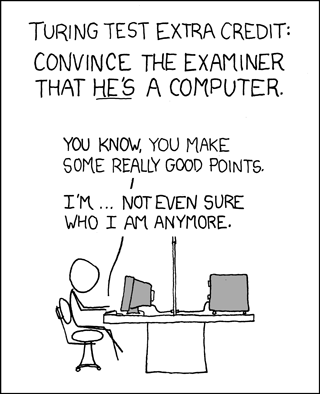
--Began the famous (and still active) Turing test, which judges whether or not a computer is capable of thought.
--Turing's codebreaking ability helped England against German U-boats.
--His work influenced the creation of high-computing languages such as FORTRAN and COBOL.


#4- Men, Machines, and the World About
Norbert Wiener, 1954
--Questioned the responsibility of technology for a social standpoint.
--Argues that the during the 1950's, the world was undergoing a second industrial revolution by replacing low level human thought with machines.

#5- Man-Computer Symbiosis
J. C. R. Licklider, 1960
--Saw computers as something that could be more than just "computing machines."
--Believed that men and computers could reason together and solve more complex problems.
--Predicted advancements in computers such as desk-surface display, wall display and speech recognition.

#6- "Happenings" in the New York Scene
Allan Kaprow, 1961
--Coined the term "Happenings," which refers to interactive art.
--Happenings are usually unconventional theater plays, but they can refer to any interactive art, even brief events.

Response: My professor gave us a scenario that ended up with one person thinking of a happening. My professor gave us a hypothetical situation where we were all spies, like in the Garden of Forking Paths. She told us that we had to somehow get the name "Lafayette" out to our spy group without having direct contact.

My suggestion? Get a street sign that says Lafayette in the city and then wrap that around my body as a belt. Then, just go on a killing spree on Lafayette Street. I would get front page on most news publications the next day, and surely the belt sign would get a ton of attention. Hence, the spy group I work for would see it (and me) and understand the message. This is NOT a happening, as the only involvement other people would have with my "art" is dying.

Another person in the class actually thought of a Happening. Her idea was to have a ton of people play dead in a park spelling out Lafayette in big letters with their bodies. This is an example of an interactive art project called a Happening.

#7- The Cut-up Method of Brion Gysin
William S. Burroughs, 1961
--By cutting out pieces of music or text and rearranging them, you can create new and interesting art; this is the cut-up method.
--Burroughs is a writer who used this method; a more contemporary example would be remix artists.

#8- Augmenting Human Intellect- A Conceptual Framework
Douglas Engelbart, 1962
--Argued that when computers gained more tools, we would adapt and become smarter ourselves and then make smarter computers, and so forth.
--However, he also warned that computers can cause of loss of basic skills, resulting in a possible de-augmentation.
--Engelbart invented the computer mouse.

Response: I referred to Engelbart's ideas when I talked about Helvetica and typeface.

#9- Sketchpad- A Man-Machine Graphical Communication System
Ivan E. Sutherland, 1963
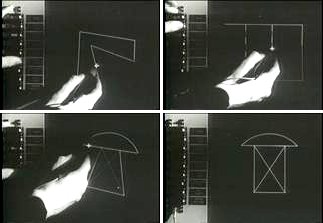
--First invention to break the barrier of computer screens only replacements for paper.
--Allows users to draw and create objects that would be impossible in physical media.
--Sketchpad laid the foundation for GUI (Graphical User Interfaces, i.e. Windows)


#10- The Construction of Change
Roy Ascott, 1964
--Distinguishes between interaction and participation in new media. Inaction is a two-way street while participation has a spectator and a set art piece.
--Some argue that Ascott's essay is the first to bring new media art to the educational public stage.

#11- A File Structure for the Complex, the Changing, and the Indeterminate
Theodor H. Nelson, 1965
--First paper to use the terms hypertext, hyperfilm and hypermedia.
--Proposes an organizational structure that allows people to jump from one idea to another.
--Combines the ideas of both Bush's MEMEX and Borges' literary style.

#12- Six Selections by the Ouilpo
Various authors, 1961, 1973, 1981
--The Ouilpo consists of potential literary works that can challenge conventional literary works.
--Founded by Francois Le Lionnais, the Oulipo methodology encourages the growth of experimental art.
--The Ouilpo was one of the first areas that allowed for the combination of computer science, literary creation and connectivity with other writers/artists.

Don't worry if you don't get what most of this means; it's just meant to show the progression of new media and technology over time. If you are interested though, check out the hyperlinks provided for more info. And just to let you know, that makes this blog post a hypertext post.

Wednesday, October 8, 2008

Look at the Typeface

You might have figured this out by now but, if there is an NYU tag at the bottom of the post, that means I have to do that post for a class. Sometimes those posts don't relate to gaming, though regardless of the post I'll probably tie it back to gaming somehow. Also, that means in those posts I should probably keep my language PG, meaning I can't just randomly say penis or things like that. Either way, the post will still be enjoyable, so feel free to read them.

Helvetica:


Helvetica is both the name of a certain typeface (font) and of a documentary I recently watched in class. The movie was surprisingly awesome, as it highlighted the birth and overuse of the Helvetica typeface in our culture. Pretty much every sign you see, either corporate or public, uses this typeface. Helvetica is widely used because of its perceived normality and non-assuming tone.

Different types of font can display different sorts of emotions. Times New Roman has a sense of formality to it, for example. And that's not just because we use Times New Roman for boring Word documents. Graphic designers would argue that Times New Roman has a sense of formality because of the way the letters are shaped and formatted.

Typeface is very important in video games as well as designers always want to convey as much emotion as possible within the confines of a text box. A game that used typeface very well was Super Paper Mario. The text was usually the same for most characters but, by either using wavy text, shaky text or all caps, you could feel more emotion coming out from the characters. Take a look at this clip below (you only need to see the first two minutes) from when Mario faces a boss called Fracktail. Notice how each character gains a different voice by the different styles in the text and the text box.


That scene actually made me laugh. In retrospect, I probably would not have laughed if Fracktail's text was not in all caps.

Obama's Typeface:
Typeface also makes a different in politics, since politicians want you to feel good when you observe their ads. Obama's campaign workers have a great grasp on how to effectively use graphic design and typeface in order to invoke positive feelings. Take a look a the campaign poster below.


The font used in this poster is called Gotham. A recent New York Times article analyzed the impact of the typeface Gotham in this poster. Here's a perplexing quote from the analyst:

"...there’s an oxymoronic quality to Gotham, which is why I think it’s become so popular. It has a blunt, geometric simplicity, which usually makes words feel cold and analytical, but it also feels warm. It’s substantial yet friendly. Up-to-date yet familiar. That’s a tough hat trick. And Gotham has another quality that makes it succeed: it just looks matter-of-fact."

It just goes to show that every little piece matters, even how the text is displayed in politics or video games makes a difference as to how you feel or interact with that object.

Augmenting Human Intellect:
Thinking in terms of typeface (and its effects) is something we really never thought about until we started using computers. The printing press was made way back in 1439 and more fonts came about over the generations. However, just look at the oddity of advertisements from as recent as the 1950's.


Text is all over the place. The ad is hokey and a little hard to read. One possible reason for why ads are smoother now (and more effective in terms of marketing) is because computers have allowed us to tackle those difficult problems of expressing emotion through print. Instead of having to conceptualize an ad, draw it, and print it, we can use computers to fine tune the ad so that it is more pleasing to the eye.

Not only have computers made processes more complex, they have also made them faster. In addition, once we have learned how to effectively use a program in order to make something more complex and faster, we then learn how to manipulate which, in turn, makes things even more complex and speedier. Humans therefore, grow with the technology, become smarter and more efficient.
----------------------

If you've read this far, you probably have two things burning in your mind right now. Go outside and see for yourself how almost everything uses Helvetica. Then, you might think about how the knowledge of Helvetica's power has grown with computers, and how you might be a bit smarter with this knowledge. Regardless, now you are at least more aware.

Tuesday, October 7, 2008

October Lookout: Little Big Planet

There are a ton of games coming out this month as people prepare for the holiday season. I don't think there is any question though, that the biggest game coming out this October is Little Big Planet for the PS3 on 10/21.


LBP is more than just a game, it looks to be the greatest level editor ever conceived. Here's a great description of what the game is all about from the Little Big Planet forum at GameFaqs:

"The LittleBigPlanet experience starts with players learning about their character’s powers to interact physically with the environment. There are obstacles to explore, bits and pieces to collect and puzzles to solve – requiring a combination of brains and collaborative teamwork.

As players begin to explore, their creative skills will grow and they will be ready to start creating and modifying their surroundings – the first step to sharing them with the whole community.

Creativity is part of the gameplay experience and playing is part of the creative experience. Players can make their world as open or as secretive to explore as they like. When it's ready, they can invite anyone within the LittleBigPlanet community to come and explore their patch -- or can go and explore everybody else's.

This genre-busting PS3 offering is turning with its quirky ragdoll, unique patchwork visual style, and revolutionary approach to level design. While you and three friends can simply tussle and hop through premade 2D stages, the game's true appeal lies in the ability to design and share your own levels.

The goal with the game is to have users creating tons of new content that will continue to keep the game active long after release. Sony has confirmed that there will be a group of set levels ready to play out of the box -- and even a single-player offline mode for those who don't want to experiment with the community ideas and simply want to play it like they would a traditional platformer." -Balloon_Popper

Creativity is the key to the game. If don't have the mindset of a level designer, you probably won't enjoy this game as much as other people. I've just started to work with level design in programs like Maya and Virtools, so I'm really excited to see how I can use the tools I've learned in class and apply it to the LBP world.

Little Big Planet is also drawing attention outside of the gaming world. The New York Times recently published an article about LBP, raving about the potential of turning gamers into creators. In fact, some students at the Parsons New School for Design (one of the premier colleges for design students) have received advance copies of the game for the purposes of creating an interactive experience. One student remarked on her LBP experience in the NY Times article:

"I don't think of it as a videogame -- even though it is, I look at it as a different form of creativity."

Since the beta came out last week, a few thousand lucky gamers have had the chance to mess around with Little Big Planet pre-release. Here are a couple of videos of some of the levels people have created and shared. Keep in mind this are completely user made so you could make levels like these with this game:


Lolz at the last video. Some people are just fixated/obsessed over one thing. Seriously though, this game looks amazing. I can't wait to play it and make some cool levels. Maybe I can make a version of my Lego Labyrinth in LBP. Hm....

I'll try to do lookout segments every month, highlighting one game of the month that I'm really excited about. Below are other big titles that are releasing this month. The links jump to the trailers for each of the respective games.

Saints Row 2: 10/14 (X360, PS3)
Wii Music: 10/20 (Wii)
Little Big Planet: 10/21 (PS3)
Fable II: 10/21 (X360)
Castlevania: Order of Ecclesia 10/21 (DS)
Guitar Hero: World Tour: 10/26 (X360, PS3, Wii)
Fallout 3: 10/28 (X360, PS3, PC)

Monday, October 6, 2008

Odd (but Useful) Gaming News Resources

Considering they update so much and have a ton of connections, kotaku is one of the best places to go if you want breaking news in the video game industry. The problem I've always had with Kotaku though, is that most of their posts seemed like they are geared and written for 13-year-olds and often times they post up a lot of rumors that should be researched a bit more before publishing.

A good place to go to is a site called PSFK. Directly from their site is a brief dscription of what they do best. "PSFK is a global trends and innovation company that helps its readers, guests and clients make things better. PSFK publishes websites and reports; hosts conferences and events; and provides advice and consultancy." This site follows various trends but, they have a section dedicated to gaming that I look at frequently. The writers get right to the point and they often write about things that you won't see in kotaku. Also, their audience is a bit older, so the articles are well-written.


The last odd place that I check is a site that shares and allows you to publish online magazines. I don't plan on making my own magazine but they do have a magazine game section that is surprisingly very professional. Considering that magazines don't publish as fast as kotaku and PSFK, this site is only good to go to every week or so but still, it's nice having a resource that isn't just a blog. The ability to publish is also a plus if you, for whatever reason, are making a magazine.

Sunday, October 5, 2008

Chelsea Galleries

I went to the galleries at Chelsea last week with my Digital New Media class. Some of the stuff I saw was really amazing, while most of it was pretty odd to say the least. Those who know me, know that I don't really have a care for "artsy" things. I dislike standing in front of paintings or sculptures, attempting (and failing) to discover the meaning behind the piece. However, add some interactivity into the mix, and suddenly and art piece can become interesting, or perhaps, even a game.

I'll break down each of the galleries I went to, tell you why I liked or disliked them, and focus on the pieces that had a little bit of a gaming edge to them, as those were cool.

Eyebeam:


You see that bag? It looks fancy. Thankfully you can tell that this is an art piece because it's placed on a pedestal. If someone were to put it on the floor, I would have thought that someone had forgotten their bag. The interesting thing about it is that when you open it up a random noise comes out of the bag. When I opened it up, it barked. I like the attempt at interactivity but I think putting an actual dog in a bag would be a lot cooler.

Bitforms:

This was an interesting concept that was taken one step too far. R. Luke Dubois looked at the State of the Union addresses for each President of the United States and compiled the words they said the most. Using that data, he placed the words on a big piece of paper in the form of an eye chart. The bigger the word is, the more times the President said it. It was a neat idea because just by seeing the biggest word you could guess what President it was. One of the words I saw was "Terror" and I immediately knew that it was our current President Bush.

However, what ruined the whole exhibit was the droning "ah" sound in the background. Apparently, that sound is the sound of a group of people singing the national anthem, but the song was stretched out to last 4 years. Yes, it's crazy, and also annoying.

David Fried:


This was legitimately awesome. Artist David Fried made a stone sculpture that reacts to sound. The balls move around whenever it hears a sound, even a footstep. Surprisingly though, this sculpture contains no electronic equipment and the artist is keeping mum on how it works. It's fun watching the balls bounce around and each different sized ball has its own personality in a sense. The big ones move slow and droopy, while the little ones bounce around like crazy constantly staying near the bigger balls. I stared at this for a couple of minutes.

Michael Zansky: The Western Lands:


I was confused by this exhibit. There were pieces of cloth lying on tables and big lenses placed in front of them, distorting the view. Some of the cloth was spinning and when you looked through the lens, you saw lots of colors and lights moving around. I tried real hard to get the point of this exhibit but as soon as I saw little dragon figurines and a sculpture of George Washington's head on one of the spinning tables, I just gave up.

Frank Gerhy building:


This building is just off the West Side Highway and it's almost completely glass on the outside. At the right time of day, the building's walls will almost be transparent; that is, of course, unless the windows aren't clean. The neat thing about the building however, is that an interactive screen will run the length of the building that people can see as they pass by either by walking or by car. The screen will advertise various products.

Doug Aitken:


This artists made a film that put undomesticated animals (such as owls, buffalo or tigers) inside area they would normally not be in, like bedrooms. In one part of the film, a tiger walked into a room and ripped apart some pillows. I was curious and slightly entertained since I do enjoy national geographic from time to time. The picture above was a particularly pretty part of the film. The owl looks very confused at the situation since he probably did not know why there were feathers falling from above. Regardless, the film was pretty.
-------------------------------

As you can see, the only piece I really enjoyed during my trip to Chelsea was the one that was most interactive: The David Fried stone sculpture. Since I am a gamer at heart, I knew I would be drawn to art pieces that involve some sort of input by me. Yelling at some balls satisfied that itch.

Monday, September 29, 2008

The Virtual Reality Cocoon

I have no idea how long this has been in development, but oh man, this looks awesome. Just take a look at the picture below. Then, realize that this thing is a computer.


Forget about going crazy over a table top computer with multi touch, this thing is the future of computers. Though I can't imagine having this contraption in my living room right now, I can see it replacing the computer desk in the long run. Besides, it just looks so bad ass.

The way it works is that you can step inside the cocoon and the Internet can become a fully 360 degree world that you can walk around in. Suddenly, instead of viewing webpages about Paris, you can actually walk through a virtual rendition of Paris. Cameras inside the machine will read your movements and you can watch and move through the various websites. You can even go shopping in this cocoon. The reference the article uses (see the first link in this post for the jump) is imagine looking for a book in amazon, walking up to a virtual bookshelf, picking out the book you want, digitally previewing it, getting other customer's opinions about the book (who also happen to be walking around) and then purchasing it. Crazy.

Now of course, I see this thing and think how awesome this could be for video games. The article also acknowledges the potential of this machine. With motion sensory equipment and fully wrap-around visuals, a first-person shooter suddenly becomes the most awesome game to play. Imagine instead of having to press a button for cover, you actually need to dive to cover to remain from getting hurt. Even better, imagine a game like Elder Scrolls IV: Oblivion where you are parrying and attacking with a sword or standing at the edge of a cliff actually shooting arrows with a virtual bow. Yeah, I know, I'm geeking out right now, but damn, the potential of this is mind-blowing. With this technology, you can actually become a video game character.

Yeah, I think this may make the brain-reading controller I just talked about obsolete.

Sunday, September 28, 2008

Telepathic Destruction... Part 2

One of my first posts on this blog was about a controller that could read the neural impulses in your mind and translate into an action on the screen. This story has really grown from two months ago, and has now reached reached mainstream news at cnn.com.


"Being able to control a computer with your mind is the ultimate quest of human-machine interaction. When integrated into games, virtual worlds and other simulated environments, this technology will have a profound impact on the user's experience."

I'm still concerned with the accuracy of the controller and with the price. Last I checked, the retail price was $169.99, which is just outrageous for a controller. Still, the potential for such a controller does have enormous capabilities, as it can provide a mechinism by which we could read the brain's thoughts and translate that into an action. I can completely see how this technology can become the controller of the future because if it is reliable, it will be much more intuitive than using a traditional controller.

Wednesday, September 24, 2008

Can a computer think?

As far as I know, computers can only be as smart as humans make them. We can program them to "think," as we have when creating a super computer that can beat the best of chess players. However, if you ask a chess playing programmed computer to do math, it will be unable to compute it if it does not have the right software.

Even computer AI characters don't think in the common sense. They are programmed to do certain actions under certain situations. By no means is this reason; it's all in the code. The code however can mimic thinking so that from the user's perspective, it looks as though the AI character is thinking.


Why is this important? Well, considering that I'm making a game (based off the lego labyrinth), I will eventually have to create AI characters. Luckily, I'm using a program called Virtools that allows me to use various scripts to create characters, so I don't need to code from scratch (I only know basic Java, HTML, and a little bit of C++).

Simulating human thinking can be tricky though since no human is ever completely correct. Sometimes, even the best thinkers make mistakes. However, what level of mistakes is considered human-like? Make a computer character do too many mistakes and the player will think the AI is flawed. Make a character be too smart and the game will become impossible. I guess the only way I'll be able to find the balance is by simple trial and error, which is also time consuming.

Gah, too much thinking, I'm only human.