Monday, November 3, 2008

Play Money, Virtual Worlds and Ludocapitalism

Don't run away just cause you saw the word "capitalism" in the blog post title. This post is about gold farming in online games like World of Warcraft, Ultima Online, Second Life, etc. I recently read this book called Play Money by Julian Dibbell and went to a lecture he had at NYU. Dibbell has an interesting story to tell: he was a gold farmer who made made thousands selling virtual gold and items on eBay. If he had gold farmed full-time and quit his writing job, he would have made more than enough money to support himself and his family; all while working at home playing games.

Below is a response paper I just finished writing for my "Hacker Culture and Politics" course relating to Dibbell's book, ludocapitalism (don't worry, I explain it), and the pleasures of work as play. It's definitely academic, but you should enjoy it.
------------------------

Julian Dibbell’s brief venture to gold farming in virtual worlds may have caused him to discover what may be the driving force of capitalist economies in the 21st century: Play. Ludocapitalism, as Dibbell puts it, is a belief that looks at the labor experience as a game and it could drive economies both virtual and real. This concept works because some theorists, as writer Martha C. Nussbaum highlights, believe that play and pleasures are the never-ending goals of human existence.


By the second half of Dibbell’s book, Play Money, Dibbell is deep into adventuring in Ultima Online (UO), a massively multiplayer online role-playing game (MMORPG), and he is raking hundreds of dollars each week buying and selling virtual goods. Instead of killing enemies and participating in traditional quests, Dibbell has decided to play game within the game world of UO, becoming a trader who sells items and gold within the game and on auctioning sites like eBay.

The goal of the Play Money project was to make more money gold farming than Dibbell has even made in a year as writer. Though he just barely failed in that goal in the end, Dibbell does admit that selling virtual goods is a viable form of living; “a $47,000 income wouldn’t have topped my best year writing, no—but on the other hand, to be honest, it would have topped all the other years” (Dibbell, 292). Since gold farming is productive then, virtual world trading is one of the first steps in actively pursuing a ludocapitalist economy.

At the lecture Dibbell gave at NYU, Dibbell makes a strong argument as to how work as play can be productive, and fun. Dibbell said that he visited a “Chinese gold farming sweatshop” in which tens of workers played World of Warcraft (WoW, another MMORPG) for 12 hours a day, seven days a week as their regular job. Despite constantly doing the same tasks over and over again, even when these workers received their break, they played their personal accounts on World of Warcraft and discussed how they could improve on their characters. The physical social environment of the sweatshop still made the game fun—despite the tedious tasks—since they were playing a game.
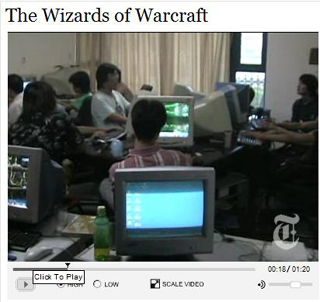

While working, many of these gold farmers stare at trading markets all day, buying low and selling high. Some of them run around in virtual cave, mining ore and creating swords with some simple keystrokes and clicks. The monotony seems similar to that of a cubicle job, checking for typos on documents and creating cover sheets for business plans. Yet, online players feel a sense of pleasure in their work; why is this?

One answer may be because games like World of Warcraft are encouraging in their nature. When you successfully mine, you may get a message saying your mining skill increased, which is rewarding and self-encouraging. The game is constantly telling you how you are improving, while most desk jobs do not. The social environment is also satisfying. Julian Dibbell made tons of friends in his UO community, from Bob to Rich and the 17-year-old Radny. He didn’t even want to be social but the game and his trading business pushed him in that direction and he seemed to enjoy the interaction throughout his book.

Since the game (and the in-game community) in constantly being supportive, there is a sense of pleasure and satisfaction even when doing work. Ludocapitalism then, works even from a production perspective. “The goal of right action is to maximize pleasure, understood as a sensation. That is the only good thing there is in the world” (Nussbaum). The bonus with gold farming is that the maximization of pleasure is also useful to the economy.

However, the birth of virtual world economies raises some troublesome questions. Since gold can be exchanged for physical dollars, virtual gold has become its own currency. And since every item in virtual world games then have a real cost, do online game players have to report their earnings to the IRS, even for something as simple as skinning in-game leather and selling it? If I were to find a rare sword and sell it, either in-game or on eBay, should I be taxed by the IRS for my trade?


As of now, the IRS is reluctant to get involved in taxing virtual worlds since they don’t know exactly how to handle it. It would be difficult for game companies to release a quarterly report of all barters within their game and then expect its players, which may include 4-year olds, to be taxed. However, what is stopping companies from converting all their assets into Linden (the currency in Second Life, another online virtual world) and then avoiding taxation on their company? The SEC, IRS and the game companies are all going to affect how virtual loot is treated from a socio-economic standpoint and if taken care of correctly, ludocapitalism can become a breakthrough for economic theory.
-------------------------

I also wrote an entry in Will's blog about gold-farming about how one study suggests that gold farming could be used to help provoke development in third-world countries. You can check that out if you want to add another layer to the discussion of virtual world trading for real economic gain.

If you have any interest in virtual worlds or online games I highly suggest reading Play Money. It's a super-quick read, very informative, and it's genuinely hilarious. That's saying a lot also, since people who know me know I don't like reading. However, I do have questions for you, if you've read this far. Do you think ludocapitalism can work as an economic model? Can games be a viable future for production?

Sunday, November 2, 2008

Digital New Media Timeline (#13 - #24)

Yep, more Digital Timeline stuff. Despite the New Media Reader textbook looking really daunting, the information is an easy read. Maybe that's because I actually like the subject. Feel free to ignore this entire post, as history may not be an interest of yours. All parts of the timeline though have affected the growth of the gaming world, though the connections may not be that easy to see.


#13- The Galaxy Reconfigured & The Medium is the Message
Marshall McLuhan, 1962, 1964
--Questioned the effect of electronic media on literary form.
--"The medium is the message" refers to how the form of information shapes human association and interaction.
--Argued that media is the extension of human senses.

Response: I just started reading McLuhan's Understanding Media, and the timeline above doesn't do justice to the influence McLuhan has had on the media world. Almost all of the authors after McLuhan reference McLuhan in some way and the statement of "the medium in the message" has influenced discourse about the effects of the internet, which has boomed on our world only recently. McLuhan's idea of "the medium is the message" was such forward thinking for its time and it did not refer only to the television, but to all forms of media both before and after he made that claim.

#14- Experiments in Art and Technology
Various Authors, 1961, 1966, 1967, 1972
-- E.A.T. is a non-profit organization that brought together computer engineers and artists in order to promote artistic new media.
-- E.A.T has helped support musician John Cage and artist Andy Warhol.

#15- Cybernated Art
Nam June Paik, 1964
-- One of the first artists to use television for art.
-- One of the pioneers of the Neo-Dada art movement (along with John Cage)
-- Paik has made robots out of television sets.
-- Paik pushed for cybernated art, which is that artists should embrace the technologies of an information society.

#16- A Research Center for Augmenting human Intellect
Douglas Engelbart and William English, 1968
-- This essay introduced the term mouse and "ARPA computer network" or ARPANet.
-- The research center is one of the first to hold demonstrations of interactive computing.


#17- From Software-- Information Technology
Various creators, 1970
-- Around this time, many artists saw information technology as a viable medium for art.
-- The PDP-8 ran Labyrinth, an interactive text retrieval system.

#18- Constituents of a Theory of the Media
Hans Mangus Enzensberger, 1970
-- Enzensberger argues that despite the big business of media, people should fight for the freedom of media in society.
-- Enzensberger believes that media is the best way to mobilize a collective populous.
-- Enzensberger argues that the formalization of written language represses opposition and the flow of sharing information.

#19- Requiem for the Media
Jean Baudrillard, 1972
-- Baudrillard argues that media acts as a poor filter that prohibits the interaction of its users.
-- He also argues that making everyone into a media producer will not help reciprocate and share ideas.

#20- The Technology and the Society
Raymond Williams, 1972
-- Williams introduced the concept "flow," which is the fluid combination of what makes up a television program, including the main content and commercials, and how that experience shapes thought.
-- Argues that while the television leads to manipulation and mindless entertainment, if the television had not been made, another technology would have taken its place and affected us in a similar way.


#21- Computer Lib/Dream Machines
Theodor H. Nelson, 1974
-- These are the fundamental texts that changed people's perception of a computer as just a "computing machine" to a computer as a viable social technology.
-- These books came out before the Altair (the first PC), and accurately predicted the effects of personal computers in our information world.
-- Nelson saw the computer as a machine that would facilitate design among people of all ages and that the experience of a computer would be liberating.
-- These books helped simplify the view of computers, making them more accessible.

Response: Computer Lib and Dream Machines looked like kid-friendly books, which, if that is the case, is a fantastic idea since children would be more willing to learn new technology and learn in faster. Regardless, the kiddy look and feel of the book changes the perception of computers, since they were viewed as machines for intellectuals and academics. Despite not being user-friendly quite yet (the books came out around the same time as the Altair), Nelson was a visionary and broke the perceptions of computers. His work alone may have pushed the development of computing technology and art by a couple years since his work inspired many to use computers.

#22- From Theater of the Oppressed
Augusto Boal, 1974
-- Boal has gone to jail for encouraging the interaction and mobilization of oppressed people in South America.
-- Boal saw theather as a medium for discourse that would bring people together under one cause.
-- Boal saw theather as a way to connect closer with the body.

#23- From Soft Architecture Machines
Nicholas Negroponte, 1975
-- One of the first people to use computers for architectural design, which, in turn, affected virtual reality architecture.
-- Negroponte founded the Architecture Machine group at MIT which heavily influenced the the design of software.
-- Negroponte is also the chairman of the One Laptop per Child movement, which makes laptops affordable for children to use around the world.

#24- From Computer Power and Human Reason
Joseph Weizenbaum, 1976
-- Weizenbaum made a successful "computer therapist" named ELIZA, that, while using simple string replacements, mimicked human reason.
-- Weizenbaum's work made people concerned that computers can and will take over all jobs that provide income.
-- Weizenbaum's computer programs showed that human beings can gain an deep emotional connection to machines.

The links I provided will really help you out if your confused as to what each of these writers/artists contributed to the New Media community. New media does include video games by the way, so knowing about this stuff will help you understand the culture that made video games before there were any video games to begin with.

Thursday, October 30, 2008

What Happened to Platformers?

I had a sad, sad revelation last night. It came after playing the new Banjo-Kazooie demo freshly released on Xbox LIVE. You see, back in the N64 days Banjo was a platformer, an action-adventure game. But Rare decided to turn my beloved franchise into a action-racing hybrid. Instead of exploring and collecting while acquiring new abilities to further explore other worlds, you build vehicles to explore and complete missions. Instead of learning new abilities you find new parts which help you find new areas. An interesting idea in theory, but the execution was horrible. Controls were clunky and objectives boiled down to brain-dead racing challenges, time trials and awkward goals (nudge the soccer ball into the goal while trying to shoot enemies with horrible aim controls). The only redeeming point of the game is the only thing Rare can apparently do right these days, which is graphics and music.


The music in particular was a throwback to the old Banjo games and almost seemed to tease a "you wish it were like this" kind of message, making me want to play the old games again. It really made me wonder - what the hell happened to the platforming genre? It used to constitute a virtual majority of video games and also a majority of the good ones. If you think back to the NES and SNES days, most games had you jumping around and navigating toward your ultimate goal lurking somewhere off screen to the right. The only obstacles in your way were spikes, pits, enemies, and sometimes lava. They were a dime a dozen and people didn't seem to ever get sick of them.

As games evolved to the 3d era the platforming genre had to evolve too. Having an extra dimension gave developers a lot more places to hide things, and so shiny objects they hid. Games like Mario 64 proved how well the transition worked; while there were still some hard jumps to be had and bosses to fight, a lot of the game revolved around exploring the confounding 3d environments and searching every nook and cranny for those 120 stars and the 8 red coins in each world.

Everyone picked up on how fun this can be, and the genre had another explosive growth. Spyro had you running and gliding for gems as a fire breathing dragon, Gex had you searching for TV remotes as a smack-talking gecko, and Donkey Kong 64 had you searching for every kind of collectible under the sun...it had over 3000 individual items to collect! Of course my beloved Banjo-Kazooie also appeared; it blended beautifully crafted worlds with a move-learning system that had your characters constantly expanding their ways of getting around. In the beginning you could only run, jump, glide and attack. By the end of the game you were dive bombing, talon trotting, egg throwing, and full-blown flying your way through levels. Later levels forced you to use the abilities while previous levels often had secrets that could be found with using all of your powers. It was a great system that made you explore, think, find things, and retroactively explore some more. I was in love.

In the last generation platformers became a bit more scarce. There were some great gems but they often were more combat oriented; examples include Ratchet and Clank as well as Jak and Daxster series. Mario had a less-than-stellar followup to 64 with Sunshine, but it was still a solid game. Other games, like the underground hit Psychonauts, still focused on jumping and collecting things.

When you get to this generation, however, counting the number of good 3d platformers is pretty easy. The answer is one - Mario Galaxy. That's it. There are a number of good 2d platformers out, the spotlight of course going to LittleBigPlanet...but seriously, what happened to the 3d platformers? I feel like the genre became forgotten overnight, replaced by the myriad of FPS / TPS games we see these days. And why this has happened completely puzzles me - Galaxy proved that the genre is not only still viable, but can be successful both critically and fiscally.

It's the kind of genre that can appeal to old and young, to both hardcore and casual. Make the main game tame with some difficult parts and then put some ridiculously hard challenges to tackle for the sought-after 100% completion. Give me some creative, innovative mechanics and some huge worlds sprawling with collectibles and hidden nooks and crannies to explore. Give me an ability system, a light but entertaining combat system maybe, and a nice story to boot. It's a pretty simple formula that's universally appealing enough to make any game that executes it well successful.


The future just looks so bleak for the genre. All I have to look forward to is Mirror's Edge, which looks promising. But I'd love to see some more platforming games come out. I don't want the genre to die - it's one of my favorite ones. I frankly don't understand why it's been such a rarity these days. What do you all think?

Tuesday, October 28, 2008

Top 52: Metal Gear Solid (#36)

The position of this game is likely to piss off some fanboys. Metal Gear Solid for the Playstation is some people's favorite game ever. I thoroughly enjoyed this game (though, not the series as much) and that's why it's on my list. Besides, #36 on a list for the best games ever is still pretty high, I think.
-------------------------------------


Title: Metal Gear Solid
Console: Playstation
Release Date: 10/21/98 (US)
Genre: Tactical Espionage Action
My Ranking: #36

Metal Gear Solid is a perfect example of how a movie script could be incorporated into a dynamic video game. Loaded with tons of cut screens, including live footage, the story within Metal Gear solid is almost guaranteed to blow your mind, even if you have no idea what the hell is going on.

I'm not even going to try to break down the story. Take my word for it though; it's awesome. Military conspiracies and threats of a nuclear attack is pretty standard for a movie script but Metal Gear Solid takes it real deep, referring back to DARPA and dabbling with genetic engineering. The story is crazy complex, and though I didn't get all of it when I was younger, it still rocked.

Most stealth sequences in games just blow. Somehow, Metal Gear Solid managed to make a game all around that style and make it incredibly enjoyable. The map in the top-right corner of the screen showed you the line of sight of the bad guys, which made it fairly easy to avoid everyone, but still fun to do since the placement of the cameras and enemies often required you to create distraction or use special items.


You learn early in the game that fighting is definitely not the answer to get past this game. This is obvious for Metal Gear Solid players now, but at the time it came out, being stealthy was not a common tactic. You knew getting into a gunfight wasn't good because the shooting controls sucked massively. Aiming was nearly impossible with the pseudo top-down view and enemies seem to never miss. Luckily, shooting never was integral to the game and the limited aiming controls were enough all of the game's bosses.

The bosses though, surprisingly, is where Metal Gear Solid was outstanding. Of course, any person who has played Metal Gear Solid knows that I need to highlight the Psycho Mantis battle. This boss is insane since he can "read your mind." Seriously, he looks inside your memory card and if you played Castlevania, he'll say, in game, that you like that game. Creepy. And, he always seems to dodge your bullets because he can read your mind. The way to beat him though, is to switch your controller from port 1 to port 2, so he can't "read your mind." Psycho Mantis broke the fourth wall is a truly creative way, and forced you to think outside the box.


The voice-acting was also superb, especially for a game made in 1998. Snake sounds like a old war veteran. Colonel Campbell sounds like a Colonel. Meryl sounds like dumb biatch. Octocon sounds like a geeky scientist. The translation was also done well, since there was a ton of subtext going on between the characters that seemed to work well in the English translation. While sometimes the conversations were too long, the deep dialogue was unprecedented in a video game. And it worked.

There are a couple of reasons why this isn't higher on my list. Though the gameplay was outstanding and the story crazy good, the game was too short. I remember beating this game in a about a week and about 50% of that time was spent only watching or reading. I get that Metal Gear Solid was designed to be plot-heavy and cut scene-heavy but it's just not my style. Luckily, the music was amazing, so when you were just watching, it was still aesthetically pleasing.


Also, as I said before, the controls needed some tweaking. Running up stairs and shooting waves of enemies shouldn't be as annoying as it was. All in all though, Metal Gear Solid felt so different from any other video game I had played up to in that time, and I knew once I finished it that I had played something that pushed gaming in a different direction, and succeeded.
-------------------------------------
My Top 52:
#52 --- Star Fox 64 (N64)
#51 --- Kirby's Adventure (NES)
#50 --- Roller Coaster Tycoon (PC)
#49 --- Grand Theft Auto III (PS2)
#48 --- Metroid Prime (GC)
#47 --- Halo 3 (Xbox 360)
#46 --- Bomberman 64 (N64)
#45 --- Guitar Hero II (PS2)
#44 --- Super Street Fighter II (GEN)
#43 --- Pokemon Puzzle League (N64)
#42 --- Soul Calibur II (GC)
#41 --- Gears of War (Xbox 360)*
#40 --- Elite Beat Agents (DS)
#39 --- Call of Duty 4 (PS3)
#38 --- Super Metroid (SNES)
#37 --- The Orange Box (PS3)*
#36 --- Metal Gear Solid (PS)

!

Monday, October 27, 2008

Real Life Achievements

As I've mentioned before, points motivate people. Even if aren't actually used or redeemed for anything. Xbox 360 took this logic, and made achievements in all of their games. Brilliance.

What if real life had achievements which motivated us to do things? Sure, there's motivations like fun, advancing your career, etc, but I want something more immediate; I demand instant gratification!

Suicidal Failure - Skydive successsfully
Poultry Pouncer - Kick a pigeon
Guardian Angel - Walk an old lady across a street

If things like this appeared in life, I feel like I would do more exciting, random things. I would ideally like them to somehow appear in my line of vision. (Want to make your own?) I realize this would require some sort of ocular implant, or awesome contact lenses, but this would be worth it:


Here's some more entertaining ones. I'm definitely not the first person to think of this type of idea. (Examples: here and here.) There are sites like 43 Things which allow you to create and complete goals, but I want something more Xbox360'esque.

Walking Tall - Create a 4 person piggy-back
Doublespeak - Invent a new language
Wild Card - Jump out of a car after cutting the brakes

Some sort of website where you go and sign up, then you can select packs like you play games, so you would select a certain set if you worked in an office job, another type if you were into extreme sports, if you were a scientist, etc, etc. You could then compare games like you can do on Xbox Live, and you'd see what achievements your friends had done.

This would have to be on the honor system, or maybe even accompanied by photographic evidence, but then again, when you're collecting gamerscore points on XBL, you only really compare yourself to your friends, not random strangers, so just don't be friends with assholes who cheat the system and say they've done things that they haven't.

(Bonus points to the first person to get the 'Wild Card' reference.)


Photo: Flickr

Godspeed.

Where all da big manuals at? (or Why's the box so small?)


Forgive me, but I do so enjoy editorializing and it’s a hard habit to shake. Kinda like politics or heroin. My next post will be a review but for now there is something I must get off of my chest.

With Fallout 3 about to hit the shelves on Tuesday and already up for purchase and download on Steam (Hah I say, hah! Digital is the future!), it’s manual was let loose a bit early. Turns out that if you preordered it on Steam they let you download the manual early. And while it’s at least a well written and designed manual it is, sadly, very short. It’s just big enough to explain the controls, vaguely explain the setting and that’s it. While some might expect that in a manual, I believe I am entitled to something a bit more impressive.

In my youth, I remember games with great and mighty manuals. Massive paper bound books that dared you to read them. If you mock me or doubt my veracity, then I say to you look upon this and cower!!

But they weren’t just massive books that explained everything about the game in painful detail. Some were cleverly written and disguised as everything from FBI reports to company presentations. And in some cases the developers actually included additional material. In the case of X-Com: Terror from the Deep, they included a booklet of interviews with soldiers from the first game describing their battles and the horror of intergalactic war, newspaper clippings from the events of the first game leading up to the second and even a couple of pages from the X-Com soldier’s handbook (complete with a soldier’s notes and doodles in the margins).

In the original Fallout, the manual included a section on surviving an atomic blast and a rather comprehensive explanation of the effects of an atomic bomb going off nearby (the vacuum created by the blast forcing out all the air followed by the sudden crushing pressure of the air rushing back in sounds rather nastier than the wall of fire).

And code wheels. Once, long ago, RPG designers would include these little paper discs, riveted together and covered in runes, letters, words, symbols and holes cut out. It was a method of copy protection but it was also kinda cool. You’d come across Dwarven runes in a dungeon and you had to use the code wheel to translate the riddle needed to continue on. It was oddly interactive and I mourn their passing.

But it seems that manuals just get smaller and smaller every year. I still remember the dark day when I noticed PC games coming in smaller and smaller boxes, eventually equaling those of console games.
In the case of Oblivion, for $10 bucks extra the "collector’s edition" of the game came with a fake coin (the currency in the game) and a book explaining the setting. The coin was not worth $10 and the booklet was the kind of thing I’d expect to get for free. However the normal version of the game came with a rather small leaflet.
Now I hear some of you saying, "But what about maps? Many RPGs come with pretty poster maps of their worlds." No, you are correct, but these are for the most part crap. Pretty crap, and I applaud the effort, but sad all the same.

What’s worse are the tech tree posters. Starcraft or Command and Conquer are great examples of this trend. They give you a chart that outlines which units each building produces and what upgrades each can receive. An interesting idea but it’s info that you have at your fingertips when you’re actually playing the game. It is the thought that counts, but the same can be said for getting socks on x-mass. (In Starcraft’s defense, the manual was nice and big and showed off all the units in game and their possible upgrades.)

There are many trends in the gaming industry that sadden me but this is one that I feel cheapens the experience for us all. And sadly, as we see digital distribution gain popularity I doubt the situation will improve. Though there are a few brief and wonderful exceptions to this decline. And to the lazy and cheap developers who have slowly strangled I say
Dotted line, #1,

10 Old School Gamer points if you can translate that one.

Saturday, October 25, 2008

Flashy Friday: Poke the Penguin

Flashy Friday? Isn't it already Saturday? Shhh. Best not think about these things. This week's segment features a classic flash "game" called Poke the Penguin. Thanks to Lima for reminding me about this one.


There's really not much to say about this one. Poke the penguin at your own risk. Hilarity ensues.

Click here to play Poke the Penguin right now.